SafetyCulture works well for teams that need fast, mobile inspections. It turns paper checklists into digital forms that anyone can complete from a phone on the floor.
However, as quality programs mature, some gaps become harder to ignore. Inspections capture issues, but the records don’t always connect to document control, corrective actions, or training.
That’s why teams start looking at SafetyCulture alternatives.
This article covers the top quality management system (QMS) options worth considering in 2026. You’ll see how each platform handles inspections, documents, audits, training, and risk so you can decide which SafetyCulture alternative suits your organization.
TL;DR
These are the five best SafetyCulture alternatives to consider in 2026:
- TLM
- SafetyChain
- QT9
- Intelex
- MasterControl
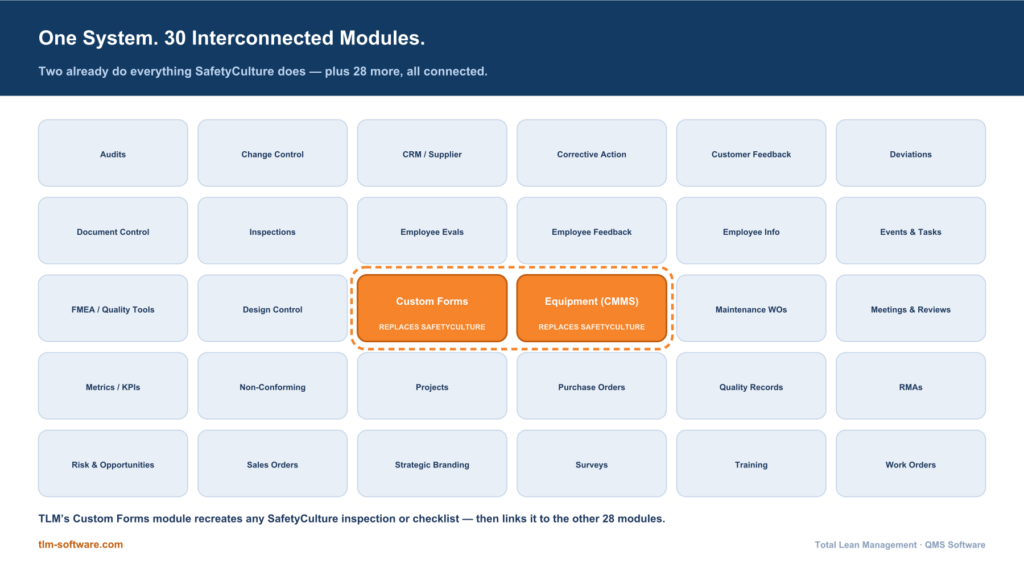
The short version: Two TLM modules — the custom form builder and the equipment module — already do what SafetyCulture does. They are 2 of TLM’s 30 interconnected modules, so your inspections don’t sit in a silo. They connect to document control, corrective actions, training, and audits automatically, which is where real compliance insight comes from.
What Is SafetyCulture?
Image source: safetyculture.com
SafetyCulture, formerly known as iAuditor, is a mobile-first inspection and operations platform used across manufacturing, construction, retail, and hospitality.
Teams use it to replace paper checklists with digital inspections captured on phones and tablets. Operators log issues, attach photos, and assign follow-up actions from the field.
Many organizations adopt SafetyCulture early, when the priority is getting inspections off paper and into a consistent digital format.
SafetyCulture includes core inspection functions such as:
- Digital checklists and inspection templates
- Issue reporting with photos and assigned actions
- Corrective actions raised from failed checks
- Sensors and asset tracking for field data
- Training courses delivered through its learning tools
- Dashboards that summarize inspection results
SafetyCulture is priced per seat. There is a Free plan for small teams, a Premium plan around $24 to $29 per user each month, and custom Enterprise pricing. Because it covers inspections only, teams often end up paying for separate document control, training, and corrective action systems on top.
As programs expand, many organizations compare SafetyCulture with QMS tools that add document control, connected records, and formal compliance workflows.
Why Organizations Look for SafetyCulture Alternatives
SafetyCulture handles field inspections well. As quality activity increases, many organizations start to notice where a checklist-first tool holds them back.
Document control is often the first gap. SafetyCulture manages inspection forms, but it does not provide controlled documents with review, approval, and version history the way a QMS does.
Records also stay loosely connected. An inspection can raise an action, but that action rarely links back to a controlled procedure, a training requirement, or a change request.
Compliance evidence becomes harder to assemble. Teams preparing for an International Organization for Standardization (ISO) or Food and Drug Administration (FDA) audit need traceable links between findings, corrective actions, revised documents, and retraining.
Training stays separate from documents. Courses live in one area, while the procedures they support live somewhere else, so it is difficult to prove that the right people were trained on the current revision.
As more departments take part in audits, document control, and change management, many organizations start comparing SafetyCulture with a full QMS that connects these processes.
5 Best QMS Software Solutions to Replace SafetyCulture in 2026
Here are the most popular SafetyCulture alternatives organizations evaluate when they outgrow checklist-based inspection tools.
1. TLM
Total Lean Management (TLM) follows established quality procedures instead of forcing new ones.
Quality leaders configure forms, fields, and approval orders to match internal processes and regulatory standards.
When procedures change, teams update them in the system, which maintains regulatory compliance and protects data integrity.
Replicates SafetyCulture in Two Modules — With 28 More Behind Them
Two TLM modules cover everything SafetyCulture does. The custom form builder recreates any inspection or checklist, complete with photos, email notifications, and approval routing. The equipment module tracks assets, calibration, and maintenance.
That is where the comparison ends and the difference begins. Those two modules are part of 30 interconnected modules inside TLM. An inspection finding can open a corrective action, trigger a document revision, and assign retraining without leaving the system.
That connection is the point. Compliance insight comes from seeing how a failed check, its root cause, the fixed procedure, and the retrained employee all relate, not from a checklist that stops at the finding.
Connects Inspections to the Full Quality Record
TLM consolidates inspections, audits, corrective and preventive actions, document control, training, supplier records, and risk data into one system.
When an inspection or audit identifies an issue, the corrective action, revised document, and required training link to the same record. This linkage supports verification and protects product quality across the product lifecycle.
Separates Manager and Employee Work
TLM separates responsibilities between managers and other users. Managers review audits, approve changes, and run management reviews in the main application.
Other users complete assigned tasks, including inspections and checklists, through a web app that shows only relevant actions. This separation keeps quality work accurate and organized.
Key Features
- Custom forms with email notifications and approval routing
- Custom fields and module names that match internal terminology
- AI-powered document search and compliance reviews
- Document control with review, approval, and full revision history
- Integrated risk, change management, supplier, and production modules
- Validation templates aligned with ISO and FDA required standards
- Connection tools that share data with enterprise resource planning (ERP) and other business systems
Regulated Manufacturing and MedTech Use Cases
Manufacturers, including medical device companies, use TLM to meet regulatory standards across quality, environmental, safety, and health programs.
The platform supports compliant workflows and audit preparation. A guided demo walks through your real processes first, so you see the orientation and account-rep support behind the software before a hands-on trial and any purchase decision.
Organizations that evaluate SafetyCulture alternatives get connected workflows, controlled documents, and real-time insight into audit status and open actions with TLM.
Book a demo to see how TLM works in practice!
2. SafetyChain
Image source: safetychain.com
SafetyChain is a digital quality and plant management platform used mainly in food, beverage, and consumer goods manufacturing.
Organizations use it to manage quality processes on the production floor. The system replaces paper checks with digital records captured during production.
SafetyChain focuses on food safety and regulatory compliance. Manufacturers use it to meet Global Food Safety Initiative (GFSI) schemes, Safe Quality Food (SQF), Food Safety System Certification (FSSC), and Food Safety Modernization Act (FSMA) requirements.
Key Features
- Hazard analysis critical control point (HACCP) and food safety checks
- In-process and finished product testing
- CAPA, incident tracking, and root cause analysis
- Configurable forms with photo evidence and context
- Dashboards for reporting and task tracking
- Supplier and co-manufacturer oversight
- Traceability across raw materials, lots, and batches
Strengths and Limitations
SafetyChain supports production environments where operators record quality checks during work. Supervisors review failed checks and open tasks without waiting for manual reports.
Like SafetyCulture, its strength is on-the-floor data capture, which makes it a natural comparison for teams moving beyond checklists.
Despite that, the platform centers on food and beverage manufacturing. Organizations in medical device, general manufacturing, or other regulated sectors may find the food-safety focus narrower than a general-purpose QMS.
3. QT9
Image source: qt9software.com
QT9 is an electronic QMS used by medical device, pharmaceutical, and biotech companies. It manages documents, audits, training, CAPAs, and risk in one system.
QT9 supports ISO and FDA requirements and runs as cloud-based or on-premises software. Organizations choose QT9 to replace manual audit tracking and scattered compliance records.
QT9 is helpful for startups and mid-sized companies that want structured quality software without a heavy technical setup.
Key Features
- Document control with revision history and approval workflows
- Audit management with scheduling, findings, and audit trails
- CAPA and nonconformance tracking with assigned actions
- Training and employee competency tracking with reminders
- Risk management aligned with ISO 14971
- Supplier quality and customer feedback tracking
- Dashboards and reports with filters and exports
Strengths and Limitations
QT9 includes onboarding resources and training videos that help users get oriented without long ramp-up periods. Dashboards show audit status, open CAPAs, and training completion in one place.
For teams leaving SafetyCulture, QT9 adds the document control and audit trails that a checklist tool lacks.
However, the interface can look busy at first, and several reports need configuration before they answer specific questions. During periods with high audit volume, reporting can slow reviews.
4. Intelex
Image source: intelex.com
Intelex is a cloud-based environment, health, safety, and quality (EHSQ) platform used by large, multi-site organizations.
Companies use it to manage inspections, incidents, audits, and compliance obligations across many locations and business units.
Intelex is often considered by organizations that, like SafetyCulture users, start with safety and inspections but need enterprise reporting and broader compliance coverage.
Key Features
- Inspection and audit management across sites
- Incident and hazard reporting
- CAPA and nonconformance workflows
- Document control and management of change
- Supplier and contractor management
- Configurable dashboards and analytics
- A large library of prebuilt application modules
Strengths and Limitations
Intelex scales across sites and connects EHS and quality data in one platform. Its analytics help leadership monitor compliance trends across the organization.
That breadth suits large enterprises with dedicated administrators.
On the other hand, that same breadth adds complexity. Smaller teams often find the platform heavier than they need, and configuration usually requires vendor involvement or internal specialists, which slows early use.
5. MasterControl
Image source: mastercontrol.com
MasterControl is an enterprise QMS used by medical device, pharmaceutical, and biotech companies.
Organizations use it to manage documents, audits, training, CAPAs, risk, and supplier quality in one platform.
Companies usually adopt MasterControl when quality operations span multiple teams, locations, and products.
Key Features
- Document control with version history and electronic signatures
- Workflow builder for audits, training, and corrective actions
- Supplier quality management with tracking
- Manufacturing modules for batch records and work instructions
- Dashboards for audit status, training completion, and CAPA activity
- Validation tools for regulated environments
- Integration with ERP and manufacturing execution systems
Strengths and Limitations
MasterControl supports large, complex quality programs. Manufacturing modules connect quality records to production, and role-based training helps users learn their tasks.
For organizations that have fully outgrown inspection tools, it offers deep enterprise capability.
However, the interface looks dated, and many workflows require multiple steps. Customization usually requires vendor involvement, which slows changes, and performance can drop during peak usage.
Replace SafetyCulture’s Limitations With TLM
SafetyCulture works well for getting inspections off paper. As audit volume increases and compliance expectations grow, many organizations start looking for a system that connects those inspections to the rest of their quality program.
TLM stands out for a simple reason. The system lets teams update forms, approval orders, and records without vendor involvement. Inspections, audits, CAPAs, document revisions, and training records stay connected.
Managers review overdue actions and approvals in one dashboard. Employees see only assigned tasks. That replaces email follow-ups, shared trackers, and manual status checks.
TLM also helps teams drive continuous improvement through connected records. Repeated findings, overdue actions, and audit trends stay visible inside the system.
Remember the short version: two modules, the custom form builder and the equipment module, already replicate SafetyCulture. They are 2 of 30 interconnected modules, so the moment you outgrow inspections, the rest of your quality program is already in the same system.
Other platforms on the market focus on narrower problems. Some emphasize food-safety checks. Others center on enterprise reporting. The right choice depends on how inspections get reviewed, how changes move through approval, and how many people need system access.
The best way to judge fit is to see it against your own processes. A demo also lets you meet the account rep who supports you and get oriented before you ever log in, which is exactly what a serious quality decision deserves.
Book a demo to see how TLM handles your inspections, audits, and daily quality work!
FAQs About SafetyCulture Alternatives
What is the best alternative to SafetyCulture?
Several platforms serve as SafetyCulture alternatives, including TLM, SafetyChain, QT9, Intelex, and MasterControl. Each option addresses different needs, such as document control, food-safety oversight, or enterprise compliance. Teams that need inspections connected to a full QMS often consider TLM first, because its custom form builder and equipment module replicate SafetyCulture while 28 more modules cover the rest of quality.
Is SafetyCulture a quality management system?
Not exactly. SafetyCulture is a mobile inspection and operations platform. It digitizes checklists and captures issues in the field, but it does not provide the controlled documents, connected records, and formal audit trails that a full quality management system offers.
How much does SafetyCulture cost?
SafetyCulture is priced per seat. It offers a Free plan for small teams, a Premium plan around $24 to $29 per user each month, and custom Enterprise pricing. Because the platform covers inspections only, organizations often add separate tools for document control, training, and corrective actions, which raises the true total cost.
What is the best QMS software?
There is only one type of quality management system, yours. The best QMS software is the one that can best adapt to how your QMS should work at your company. Many organizations consider TLM when they need more control over approvals, records, and audits, using system settings, custom fields, and the custom form builder.
What is the starting price for QMS software?
Starting price varies widely depending on the platform, number of users, and required modules. Some systems appear affordable upfront but increase costs as access expands. Organizations should expect pricing to reflect long-term usage, not just initial setup.