One audit can expose every weakness in a quality system. Missing records and outdated procedures often stay hidden until it’s too late, which is why manufacturers need to understand the different types of quality management systems (QMS).
This guide explains the main types of QMS and how each one works in manufacturing environments, so you can see which setup fits your operation.
TL;DR
- The main types of QMS include implementation, methodology, standards-based, and industry-specific systems.
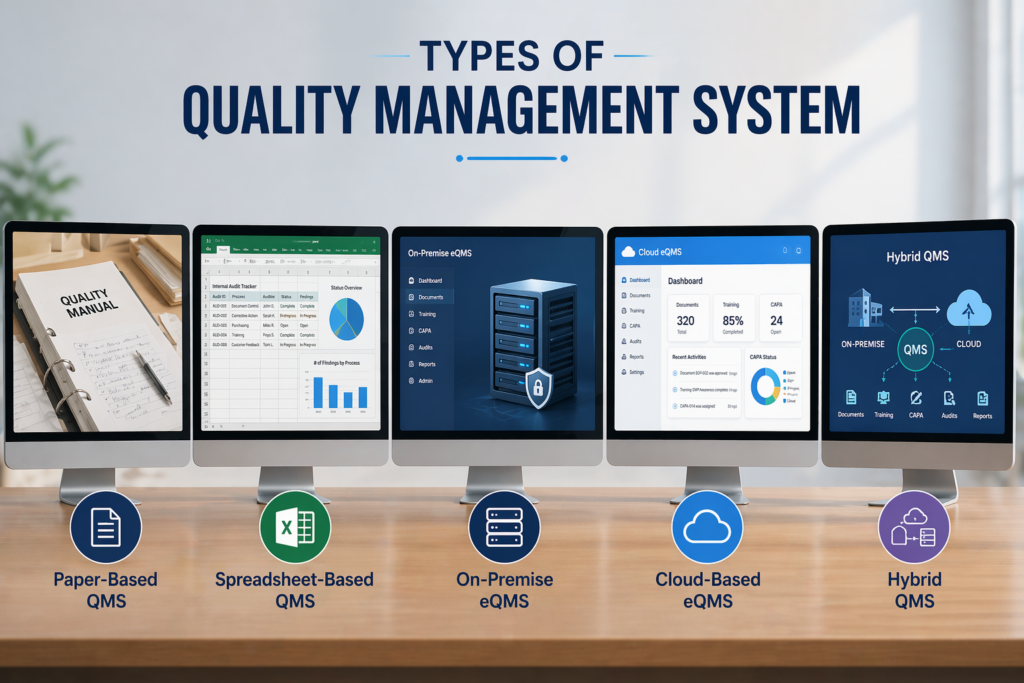
- Implementation formats range from paper, spreadsheets, on-premise systems, cloud-based systems, and hybrid setups.
- Methodologies include total quality management, Six Sigma, continuous quality improvement, lean management, and quality function deployment.
- Standards-based QMS follow frameworks like ISO 9001, ISO 13485, ISO 17025, IATF 16949, and food safety systems.
- TLM connects key QMS processes in one system, linking documents, audits, CAPA, and training modules.
What Are the Main Types of QMS?
The main types of QMS fall into four groups.
- Implementation-based quality management systems describe how a company runs its system. This includes paper records, spreadsheets, or digital quality management software with document control, audits, and corrective and preventive action (CAPA).
- Methodology-based quality management systems shape how a company improves product quality. Total quality management (TQM), lean management, and continuous quality improvement guide process improvement and help meet customer expectations.
- Standards-based quality management systems follow frameworks such as International Organization for Standardization (ISO) requirements, setting expectations for regulatory compliance.
- Industry-specific quality management systems reflect the needs of sectors like medical devices, pharmaceuticals, and food safety, each with its own regulatory requirements.
Most manufacturers combine these types rather than relying on just one.
Types of QMS by Implementation Format
The way a company sets up its quality management system affects how people handle documents, track quality data, and get through audits.
Paper-Based QMS
A paper-based QMS uses printed procedures, physical records, and manual approvals.
You’ll still see this in operations with simple manufacturing processes or limited regulatory requirements. Binders, printed standard operating procedures (SOPs), and manual logs hold all quality records.
Problems show up when documents are updated. Audit preparation takes longer, and finding records for regulatory compliance slows everything down.
Spreadsheet-Based QMS
A spreadsheet-based QMS uses Excel or Google Sheets to track quality control processes and store quality data.
It replaces paper logs with digital files. Issues, inspection results, and quality objectives are recorded in spreadsheets instead of binders.
Over time, files get duplicated, formulas break, and links between records weaken. During regulatory audits, it becomes harder to prove traceability or connect records to quality management system requirements.
On-Premise eQMS
An on-premise electronic quality management system (eQMS) stores data on internal servers.
Companies in regulated industries like medical device manufacturing choose this setup to secure quality documents and sensitive data.
It takes more effort to maintain. Setup costs run high, IT staff manage updates, and sharing quality data between locations or suppliers can be limited.
Cloud-Based eQMS
A cloud-based eQMs stores documents and records online.
Quality documents, CAPA management records, and audit management data can be accessed and updated without relying on file transfers. Updates apply to everyone at the same time, which helps maintain consistent quality.
Manufacturers often use this format to connect quality management software with supply chain management and keep up with ISO standards.
Hybrid QMS
A hybrid QMS mixes paper, spreadsheets, and digital tools.
This is often used during a transition. One department may track audits in software, while another still records inspections or training on paper.
This setup splits quality data between systems. It becomes harder to trace issues, review records, and maintain consistent quality in the manufacturing process.
Types of QMS by Quality Management Methodology
Quality management methodology explains how a company improves quality, controls defects, and meets customer requirements. It guides how quality processes are carried out in the manufacturing process.
Total Quality Management
TQM treats quality as a shared responsibility across the company.
It centers on customer satisfaction, employee involvement, and continuous improvement in daily work. Leadership sets direction, and employees take part in improving quality processes and meeting customer needs.
Manufacturers use TQM when they want consistent product quality and stronger customer focus throughout operations.
Six Sigma QMS
Six Sigma uses data and statistical process control to reduce variation and defects.
It follows the DMAIC method, which stands for Define, Measure, Analyze, Improve, and Control. This method uses quality data to find root causes and fix them.
This approach fits manufacturers that need precise control over product quality and want measurable results linked to business goals.
Continuous Quality Improvement
Continuous quality improvement (CQI) focuses on small, steady improvements in business processes.
It uses customer feedback, performance data, and regular reviews to refine how work gets done. Adjustments happen over time rather than through large, one-time changes.
Companies use CQI when they want continuous improvement built into daily operations and quality assurance efforts.
Lean Management
Lean management targets excess inventory, delays, and unnecessary steps that affect cost and delivery. The goal is to improve efficiency while maintaining quality standards and customer value.
Manufacturers often pair it with other quality management standards, especially in regulated environments like the medical device industry.
Quality Function Deployment
Quality function deployment (QFD) connects customer requirements to product design and production decisions.
It uses tools like the House of Quality to map customer needs to engineering specifications. This helps guide product development and improve how companies deliver quality service.
QFD is useful in product-driven industries where meeting customer expectations depends on design accuracy and early planning.
Types of QMS by Standards and Compliance Framework
Standards-based QMS follow formal requirements that set expectations for how companies document processes, manage quality, and prepare for audits.
- ISO 9001: The most common quality management system standard used in various industries. It sets a foundation for managing quality processes, improving customer satisfaction, and maintaining consistent output through documented procedures and leadership commitment.
- ISO 13485: Used by medical device manufacturers and the life sciences industry. It focuses on regulatory compliance, risk management, traceability, and patient safety. It reflects the strict requirements involved in medical device production and distribution.
- ISO 17025: Used by testing and calibration labs to verify the technical accuracy and reliability of results.
- IATF 16949: Used in automotive manufacturing. It emphasizes supplier quality management, defect prevention, and production consistency.
- Food safety standards: Frameworks such as ISO 22000, Hazard Analysis and Critical Control Points (HACCP), and Safe Quality Food (SQF) apply to food production. They focus on hazard control, product safety, and meeting international safety requirements.
Types of QMS by Industry Focus
Each industry follows its own rules, and the QMS reflects the risks, products, and regulatory requirements involved.
Medical Device Industry
Medical device manufacturers deal with strict safety and compliance requirements.
Their QMS covers design controls, complaint handling, CAPA, and full traceability. Post-market surveillance tracks how devices perform after release and helps catch issues early.
ISO 13485 and FDA expectations set the baseline. When a device fails in the field, manufacturers trace affected units, document the investigation, and show evidence that the issue was resolved before audits.
Pharmaceutical and Biotech Industry
Pharmaceutical and biotech companies rely on detailed records and strict process discipline.
Batch records capture every step, from raw materials to final release. Validation confirms that equipment and processes meet quality standards, and deviation handling records any departure from approved procedures.
If a storage unit exceeds temperature limits, the event gets logged, reviewed, and investigated to meet regulatory requirements and minimize risks.
Automotive Industry
Automotive manufacturing focuses on preventing defects before products leave the line.
Manufacturers use failure mode and effects analysis (FMEA) and statistical process control (SPC) to monitor production. Supplier quality management checks that incoming parts meet specifications.
When a supplier sends a defective part, the manufacturer reviews the issue, applies corrective action, and tightens inspection checks to protect product quality.
Food and Beverage Industry
Food safety management systems deal with contamination risks and product safety.
HACCP identifies stages like cooking, cooling, or storage where risks can occur. Preventive controls monitor these steps to meet international safety standards.
If contamination is detected, recall procedures trace affected batches and remove them from distribution.
Healthcare Industry
Healthcare providers focus on patient safety and service quality.
Their QMS tracks incident reports, manages policies, and monitors staff competency. Corrective actions address root causes and update procedures.
A medication error triggers a review. Protocols are updated, and staff receive additional training to prevent it from happening again.
Core QMS Documents Every Organization Needs
Every quality management system relies on four document groups. They keep QMS processes consistent and give auditors proof that people followed the required steps.
- Policies: These set direction and state the company’s quality intent. They connect quality work to customer requirements, service requirements, and business goals.
- Procedures: These explain how work should be done. They standardize routine activities so production, inspections, and approvals follow the same method and meet industry standards.
- Work instructions: These take a step further than procedures. They spell out the exact steps for a specific task, such as setting up equipment, checking a part, or recording a test result.
- Records: These show what happened. Training logs, inspection results, and audit reports prove that employees followed procedures, which is essential for traceability and compliance.
Why Many Manufacturers Outgrow Basic QMS Formats
Basic QMS formats only work when records stay connected and easy to retrieve.
Paper systems slow audits. Procedures, training logs, and inspection records often sit in separate binders, so finding a single document takes time.
Spreadsheets add version problems. Two files may track the same defect data, but only one reflects the latest update. During an audit, this makes it harder to confirm which file reflects actual results.
Disconnected tools weaken traceability. A nonconformance may appear in one system, CAPA in another, and training records somewhere else.
Manual reporting adds another hurdle. Quality data gets copied into reports, so trend reviews happen less often.
At that point, many manufacturers move toward a more connected quality management system software like TLM.
Keep Your Quality System Organized and Audit-Ready With TLM
Most manufacturers don’t rely on just one QMS model. They combine methods, formats, and compliance requirements, which can make quality work harder to manage.
TLM works in that environment. It gives manufacturers a QMS that helps them meet common quality management standards and keep quality processes organized as operations become more complex.
TLM covers the main functions that keep a quality system working:
- Document Management keeps policies, procedures, and records organized
- Corrective Action tracks issues and investigations
- Audits connect findings to supporting records
- Training tracks qualifications and completed procedures
- Change Control records updates to processes and documents
- Customer Feedback connects complaints to investigations
- Meetings and Reviews document decisions and follow-ups
- Metrics track performance against quality objectives
- Quality Records stores documentation for audits
- Electronic Forms standardize data entry and approvals
TLM includes 30 configurable modules, so companies can set up the system around their own quality processes.
Instead of using spreadsheets for unique quality data that might be outside of these 30 modules, TLM allows companies to build controlled custom forms in the web app exactly how they need them to look, and even includes dashboard-integrated approvals.
It connects with enterprise resource planning (ERP) and other business systems, which helps manufacturers predict quality issues earlier and keeps quality work close to business success.
FAQs About the Types of QMS
What are the main types of QMS?
The main types of QMS fall into four groups. These include implementation formats, quality management methodologies, standards-based systems, and industry-specific systems.
Most manufacturers combine these to manage quality and increase customer satisfaction.
What is the difference between a QMS and an eQMS?
A quality management system (QMS) covers the full set of processes, documents, and records used to maintain product and process quality.
An electronic quality management system (eQMS) is a digital quality management solution that manages those same processes using software.
Is ISO 9001 the same as a quality management system?
No. ISO 9001 is a set of requirements that companies follow when they set up and maintain their modern quality management system.