


Manufacturers don’t look for quality management system (QMS) software out of curiosity. They start searching after audits, customer demands, or internal failures expose weak quality systems.
Manufacturing QMS software fixes those problems by replacing manual quality work with a system teams can rely on every day.
This guide compares leading manufacturing QMS software platforms and breaks down what each one offers, so you can focus on the tools worth your time.
TL;DR
Here are the seven best manufacturing QMS software options for manufacturers:
- TLM
- ComplianceQuest
- SimplerQMS
- EASE
- Advantive
- QT9 QMS
- Qualityze
How Do Manufacturers Use QMS Software Solutions?
Manufacturing QMS software handles quality work inside manufacturing operations, not only during audits.
Teams use quality management software to manage document control, employee training, and nonconformance, audit, and risk management.
That replaces manual processes with repeatable QMS processes that teams follow without relying on reminders.
On the factory floor, manufacturing quality management software provides access to approved work instructions, product specifications, and version control for quality documents.
Supervisors verify employee training before assigning tasks. Quality teams record quality events, customer complaints, and quality issues as they occur.
That creates reliable quality data connected to manufacturing processes.
Why Manufacturers Rely on QMS Software
Manufacturing QMS software fixes gaps in quality management processes that manual systems leave behind.
Quality processes fail when procedures change, but production processes don’t follow. That leads to inconsistent product quality and customer complaints.
Traceability is another issue. When quality issues surface, teams often lack reliable quality data to connect defects, approvals, and corrective actions.
Quality management system software keeps records linked, so decision-making doesn’t rely on assumptions.
Supplier quality management also creates risk. Poor supplier performance and missed inspections affect raw materials and finished products. QMS software records supplier issues and corrective actions so problems don’t repeat.
Regulatory compliance solutions expose weak systems fast. Industry regulations require complete documentation and proof of continuous improvement.
Digital QMS solutions help manufacturers meet compliance requirements and maintain quality standards.
7 Best Manufacturing QMS Software Solutions in 2026
Manufacturing environments demand different QMS capabilities. Some systems stop at documentation. Others support production, suppliers, and inspections.
Here’s a comparison of the top manufacturing QMS software solutions.
1. TLM
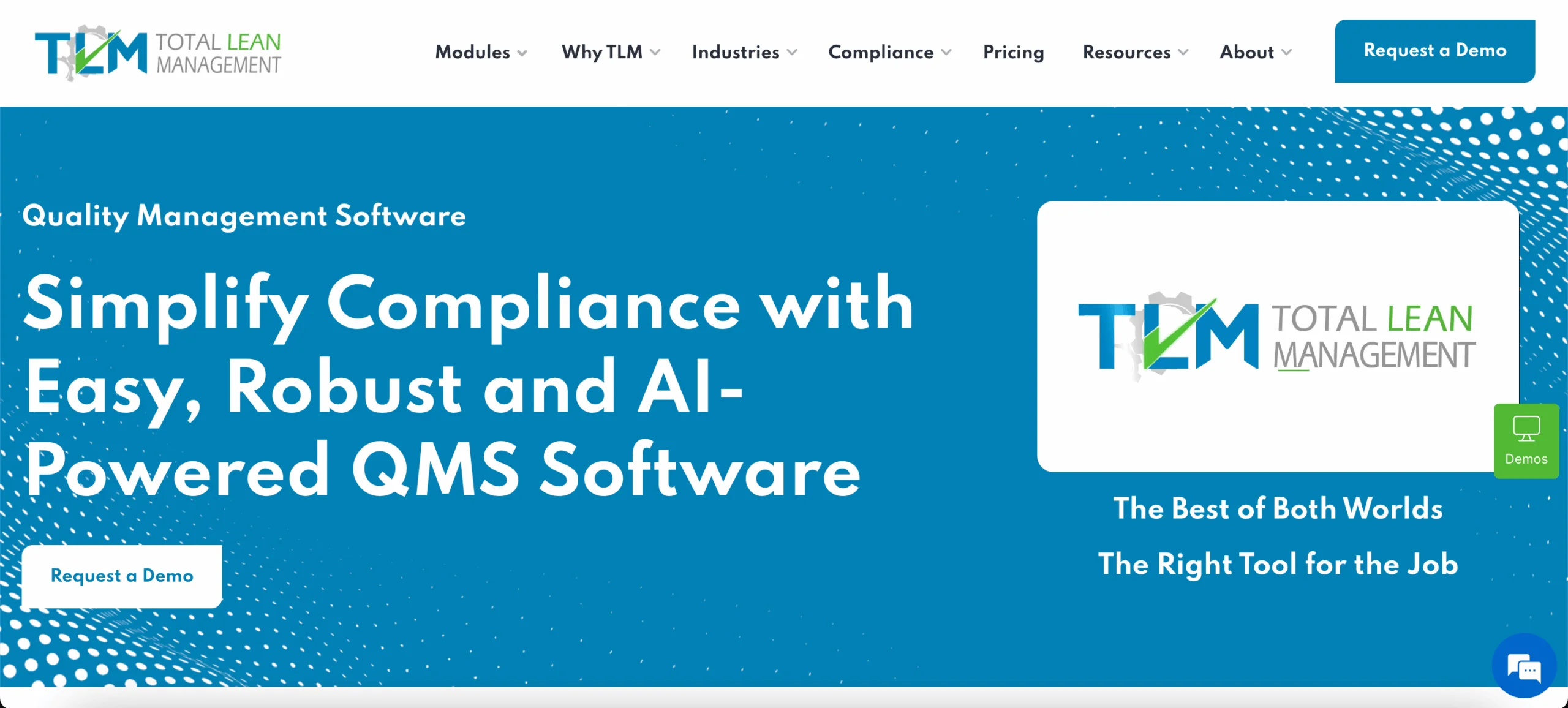
Many manufacturing companies run purchasing, inventory, and production through an enterprise resource planning (ERP) system. Replacing that system usually isn’t realistic.
Total Lean Management (TLM) connects with existing ERP systems, so inspections, nonconformance reports (NCRs), vendor approvals, purchase orders, work orders, and inventory data remain part of one QMS.
Quality work stays connected to production instead of becoming a separate task that slows teams down.
Key Features
- Dedicated applications for different user groups, including management and shop-floor users
- Template procedures for ISO 9001, ISO 13485, ISO 17025, ISO 16949, ISO 27001, and ISO 22000
- 21 CFR Part 11 compliance for regulated manufacturing environments
- Custom form generator with approval workflows
- Modules for inspections, supplier quality, inventory, work orders, and purchasing
- Artificial intelligence (AI) assistance for document search and compliance reviews
- 30-day supported free trial with data, document, and template uploads
Works With Existing Production and Material Data
Quality management software has to connect to material and purchasing data to stay useful.
TLM imports parts, purchase orders, inspection results, and NCRs from ERP systems and makes that information available throughout the QMS.
Inspections, supplier quality management, and change management activities remain connected to purchasing and production activities.
There’s no need to re-enter data or manage quality work in separate systems.
Handles ISO, FDA, and Regulated Manufacturing Requirements
TLM provides a complete solution for International Organization for Standardization (ISO) certification and Food and Drug Administration (FDA) regulated manufacturing.
Validation templates support ISO 13485 certification for medical device companies.
Approval workflows and certification-ready procedures help teams meet regulatory requirements without rebuilding their quality system for each audit.
Used Daily by Quality and Production Teams
TLM uses a mobile-friendly web application to deliver daily QMS tasks to the people responsible for completing them. Training videos link directly to internal training records.
Inspections, work orders, inventory status, and quality records remain connected. That helps you improve quality, meet customer requirements, and reduce rework due to quality errors.
2. ComplianceQuest
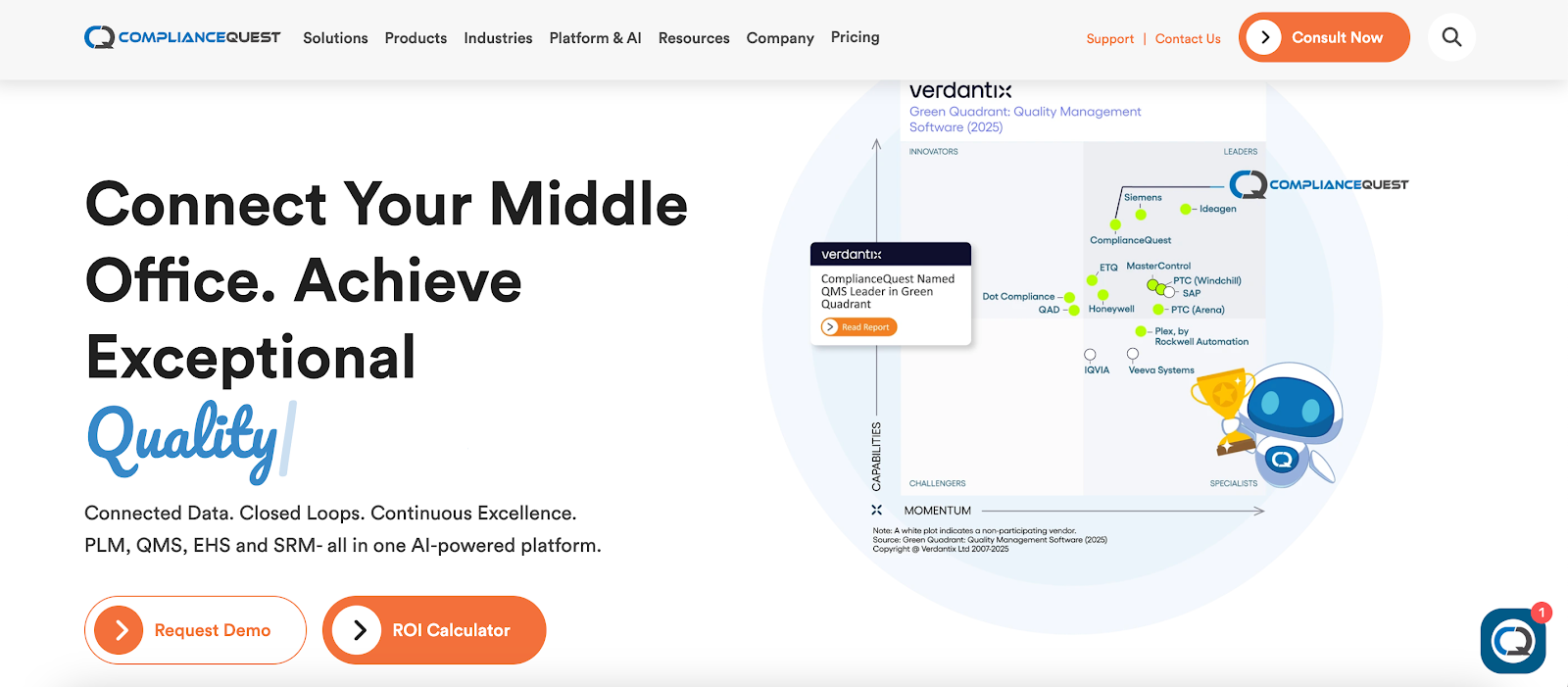
Image source: compliancequest.com
ComplianceQuest is a cloud-based solution used by manufacturing companies that manage high volumes of quality activity and reporting.
The platform uses a shared data model to handle audits, inspections, corrective actions, and change activity in one system.
Quality teams review quality metrics and trends using real-time data instead of static reports, which supports issue review and follow-up.
Key Features
- Audit planning, scheduling, execution, and report generation
- Corrective action and preventive action (CAPA) with root cause analysis and effectiveness review
- Nonconformance management with investigation workflows and escalation logic
- Change control with documented workflows and impact assessment
- Equipment management for calibration and preventive maintenance tracking
- Product inspection for receiving, in-process, and finished goods
- Management review dashboards with quality metrics
ComplianceQuest connects quality workflows with enterprise applications commonly used in manufacturing environments. Organizations use this setup for reporting and compliance activities.
3. SimplerQMS
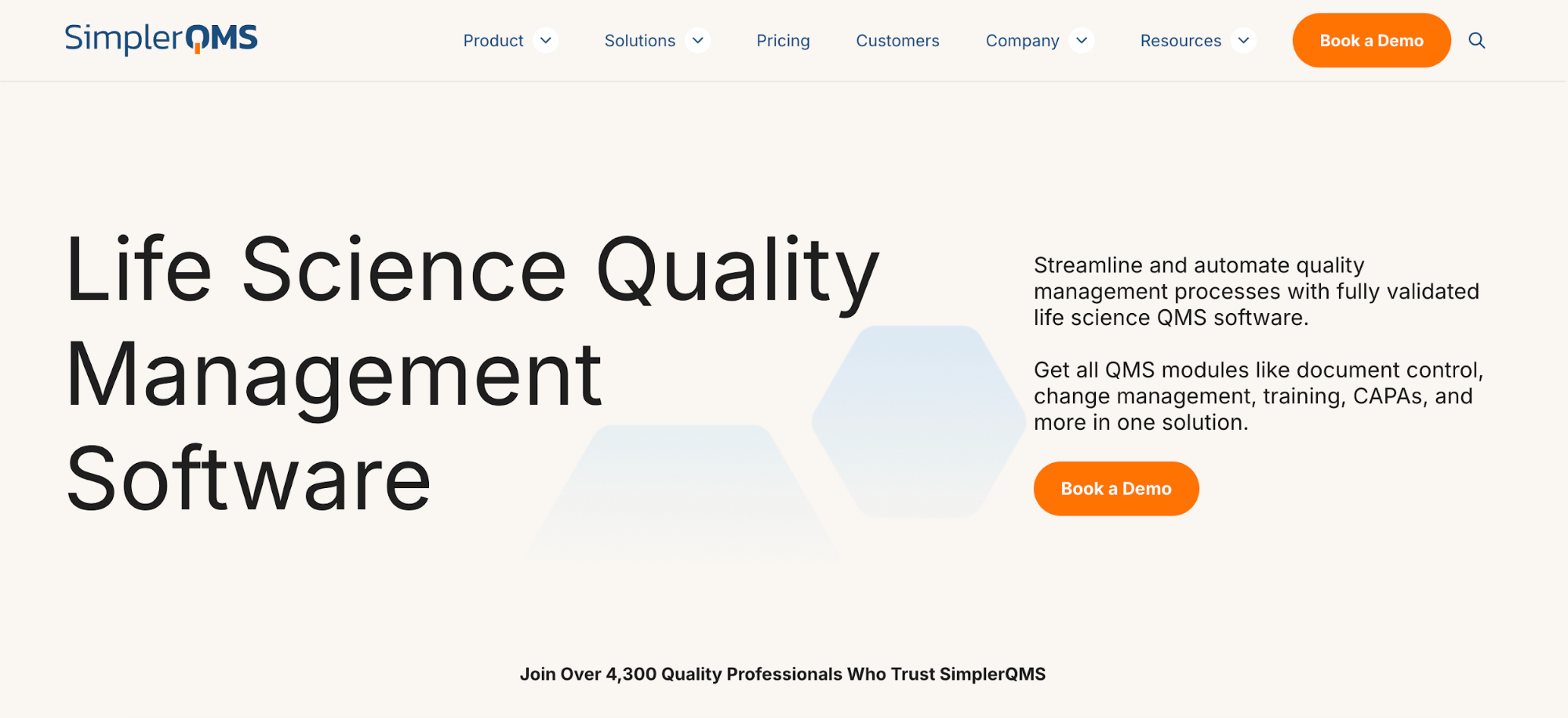
Image source: simplerqms.com
Organizations use SimplerQMS in regulated manufacturing, including life sciences, where document history and audit preparation carry heavy weight.
The system manages quality processes through predefined workflows that connect documents, training tasks, audits, nonconformances, and corrective actions in one place.
Document control is the core of SimplerQMS. Users create, review, approve, distribute, and archive documents through automated workflows.
Every version carries a time-stamped audit trail, and only approved versions remain available.
Electronic signatures that meet FDA 21 CFR Part 11 and EU Annex 11 requirements support remote approvals without paper handling.
Key Features
- Document management with version control and audit trails
- Training management tied to released and updated documents
- Change management with workflow-based review and approval
- Audit management for internal, external, and supplier audits
- Nonconformance handling with escalation to CAPA
- Risk management documentation with traceability matrices
- Supplier management tool for quality documentation and monitoring
Quality data flows through linked workflows that connect documents, training records, nonconformances, CAPAs, and risk files in one system.
This setup helps organizations maintain consistent product quality and manage regulatory expectations.
4. EASE
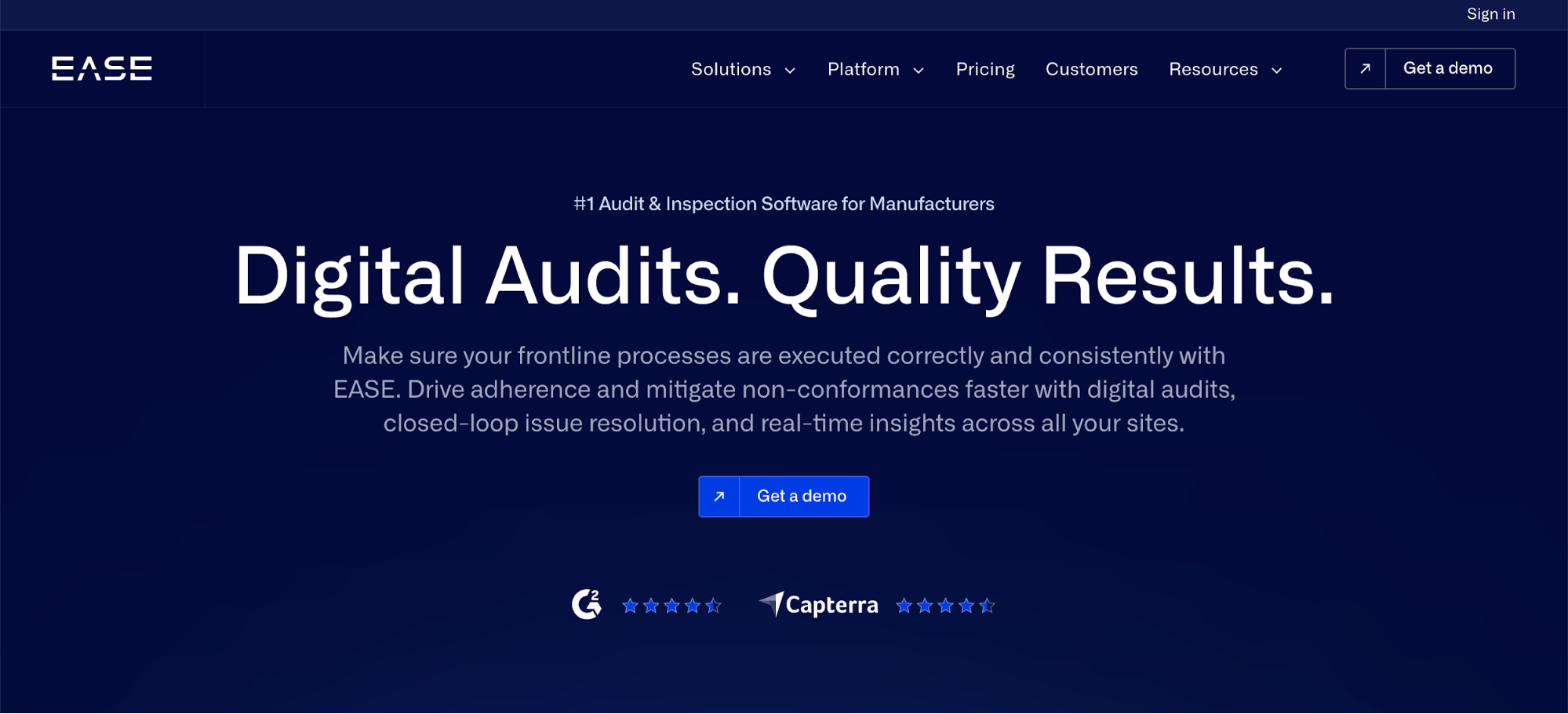
Image source: ease.io
EASE is a cloud-based platform used in manufacturing to run digital audits and inspections and track corrective actions.
It’s commonly used for quality audits, safety inspections, and operational checks while collecting consistent data from one or multiple sites.
Audits run on mobile devices, even offline. Users capture findings, photos, and videos during the audit, then assign follow-up tasks immediately.
Each finding connects to an action plan, an owner, and validation tasks, so corrective work remains connected to the original audit.
Scheduling covers one-time and recurring audits for sites, areas, lines, or stations. This helps apply the same audit standards at different locations without manual coordination.
Key Features
- Mobile audits and inspections with offline access
- Configurable audit templates by site, area, and workstation
- Scheduling for recurring and ad hoc audits
- Question randomization to improve data collection accuracy
- Action plans with task assignment and validation tracking
- Root cause analysis tasks linked to audit findings
- Photo, video, and attachment capture during inspections
- Dashboards and reports for single-site and multi-site review
EASE focuses on audits, follow-up actions, and reporting rather than full quality system coverage.
Reports combine results from multiple locations so teams can spot patterns, address performance gaps, and maintain continuous quality improvement.
5. Advantive

Image source: advantive.com
Advantive focuses on product testing, inspection, and traceability during production rather than post-production review.
Quality test requirements are set electronically by the plant, product specification, customer, or job.
Test results are captured directly from connected testing devices when available. This reduces manual entry and keeps inspection records connected to production activity.
Quality managers can review inspection results before shipment and reference documented results when handling customer complaints or returns.
Key Features
- Electronic setup of quality test requirements by plant, product, or customer
- Product testing with direct data capture from testing equipment
- In-process and finished goods inspection with recorded results
- Product traceability linked to jobs, materials, and specifications
- Certificates of Conformance (COC) and Certificates of Analysis (COA) generation
- Alerts when required tests are skipped or when results are missing
- Integration with inventory, production planning, and material management
- Support for ISO requirements and documented quality processes
Advantive’s QMS operates within a broader manufacturing software environment, connecting quality data with inventory usage, production planning, and material flow.
This connection keeps test results linked to production outcomes and maintains consistent product quality in industries such as automotive manufacturing.
6. QT9

Image source: qt9software.com
QT9 is a flexible QMS platform that covers document control, audits, corrective actions, training, calibration, supplier quality, and product traceability.
The system keeps quality activity linked to manufacturing operations instead of handling it separately.
Quality events such as nonconformances, corrective actions, supplier issues, training status, and calibration records remain traceable through reports and dashboards.
This helps maintain closed-loop quality, where issues link to actions, follow-up, and history.
QT9 also provides secure portals for customers, suppliers, and employees to access quality documents and records.
Key Features
- CAPA workflows with root cause tracking
- Audit management for internal and external audits
- Nonconformance reporting with risk assessment and escalation
- Supplier qualification and performance tracking
- Employee training matrices and certification tracking
- Equipment calibration, scheduling, and maintenance records
- Product traceability from raw materials through finished goods
- Quality dashboards and key performance indicators (KPIs)
QT9 also offers material requirements planning (MRP) and ERP software. QT9 MRP handles scheduling, inventory, work orders, and purchasing while integrating with accounting systems such as QuickBooks or Xero.
QT9 ERP adds accounting and financial reporting, creating an integrated solution that connects quality, production, and inventory data.
7. Qualityze
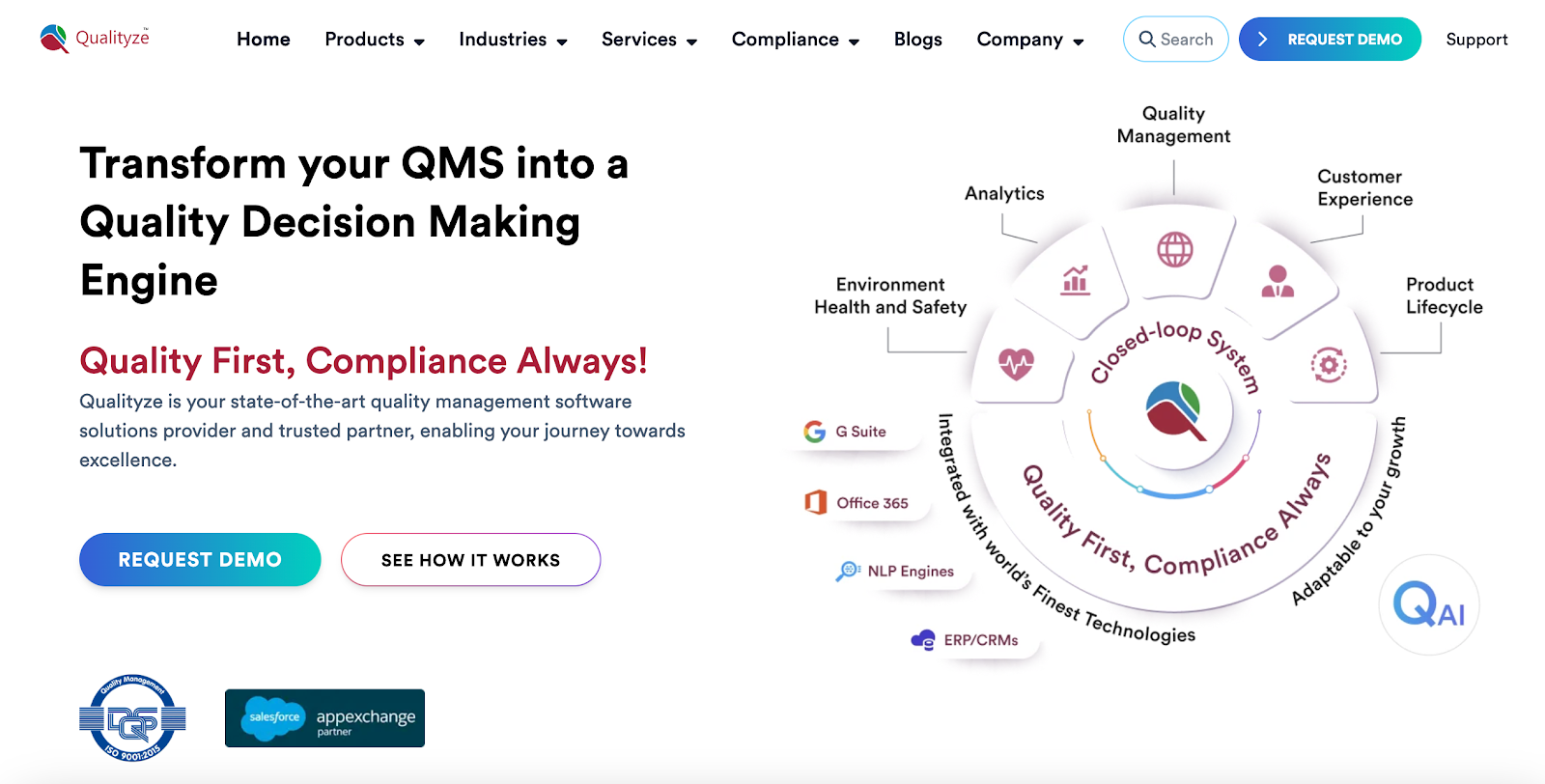
Image source: qualityze.com
Qualityze is an enterprise quality management system (eQMS) used in manufacturing to manage compliance, supplier quality management, and safety workflows.
It covers industry standards and regulations such as ISO 9001, ISO 45001, and ISO 50001.
Qualityze uses configurable workflows for nonconformance management, CAPA, audit management, document control, equipment calibration, and incident reporting.
Key Features
- Document control with workflow automation, version control, and access controls
- Nonconformance management with routing and investigation tracking
- Audit management for internal assessments and certification activity
- Equipment calibration and maintenance scheduling with notifications
- Safety incident and near-miss management with investigation workflows
- Configurable workflows and fields for internal process requirements
- Cloud-based platform with automatic updates and system integrations
- AI assistant for workflow guidance and issue analysis
Qualityze is often reviewed by manufacturers that deal with regulatory changes, supplier risk, and safety reporting.
The focus is on compliance requirements and process management that helps maintain customer satisfaction, protect brand reputation, and reduce costs.
Keep Quality Records Linked to Parts, Orders, and Inventory in TLM

When you compare manufacturing QMS software side by side, the difference isn’t the feature list. It’s where quality work happens during production.
Many systems push quality into a separate workspace. TLM keeps quality work part of daily manufacturing activity.
Inspections reference the same parts and purchase orders used on the floor. Supplier issues point back to receiving data.
Nonconformance reports connect to work orders and inventory status. Quality records reflect what happened, not what someone entered after the fact.
This makes statistical process control and trend analysis more useful. Inspection results come straight from production activity, which helps spot repeat issues and reduce defects before shipment.
Manufacturers choose TLM when quality tasks need to happen while work moves forward, using the same data production already relied on.
FAQs About Manufacturing QMS Software
What is the best QMS software?
There is only one type of quality management system, yours. Therefore, the best QMS software is the one that can best adapt to how your QMS should work at your company.
TLM stands out for manufacturers who need inspections, nonconformances, approvals, and training to happen during active work. That connection helps maintain quality excellence without slowing production.
What is the QMS system for manufacturing?
A QMS system for manufacturing manages quality activities such as inspections, corrective actions, audits, and training within production workflows.
It keeps quality records linked to parts, orders, and suppliers so results reflect what actually happened on the floor. This helps manufacturers meet customer expectations while maintaining consistency.
What is the best software for manufacturing?
There’s no single answer for every operation, but manufacturers choose TLM when quality work stays connected to purchasing, inventory, and work orders.
That linkage helps maintain high-quality products by keeping inspection results and corrective actions connected to production activity.
What are the four types of QMS?
The four common types of QMS include ISO-based systems, total quality management, Six Sigma, and industry-specific quality systems.
Manufacturing-focused QMS software often blends these methods to support operational excellence while meeting regulatory and customer requirements.



 Demos
Demos