

If you’re exploring QT9 QMS alternatives, you’re likely questioning whether QT9 still meets your quality and compliance requirements.
QT9 delivers strong document control, corrective and preventive action (CAPA) management, audit tracking, and regulatory support. However, as your organization grows, you may need more advanced reporting, refined workflows, or stricter control over user access.
Choosing the right quality management system (QMS) influences audit outcomes, product standards, and regulatory standing.
Below, you’ll find the top QT9 QMS alternatives to help you identify which platform aligns with your industry and compliance demands.
TL;DR
Here are the top QT9 QMS alternatives worth considering in 2026:
- TLM
- MasterControl
- Ideagen
- Qualio
- ComplianceQuest
- ETQ Reliance
- SimplerQMS
Overview of QT9 QMS Software

Image source: qt9software.com
QT9 is a quality management software platform used in regulated industries such as medical devices, pharmaceuticals, manufacturing, aerospace, and laboratories.
It helps you manage documents, audits, corrective and preventive actions, risk records, complaints, inspections, and employee training in one system.
The platform includes more than 25 modules. These cover document control, change control, supplier management, and regulatory compliance.
The system logs actions through audit trails and electronic signatures, which helps during inspections and internal reviews.
For many teams, QT9 becomes the system used to run daily quality operations. Still, no platform works perfectly for every organization.
Why Companies Look for QT9 QMS Alternatives
QT9 covers a wide range of quality and compliance functions. But as your team grows or your regulatory scope expands, certain limitations may become more noticeable.
That’s usually when companies start researching QT9 QMS alternatives.
Here are the most common reasons:
- Reporting feels limited: Standard reports may not provide enough depth to track trends in CAPA, audits, or change control. Leadership typically expects clearer insight into risk exposure and performance patterns.
- Setup takes time: Some modules require pre-requisite configuration before they operate fully. For lean teams, that setup can slow adoption and delay results.
- The interface requires adjustment: The layout can appear busy at first. Training multiple departments may take longer than anticipated.
- User permissions need more precision: In regulated environments, tighter control over document access and record linking is often necessary, especially for safety events, complaints, and CAPA records.
When these challenges begin affecting oversight or audit readiness, it makes sense to evaluate other options.
Top 7 Quality Management Systems to Replace QT9
If you’re comparing various platforms, start with these QT9 QMS alternatives. Each serves regulated organizations in various industries, but their strengths vary in customization, analytics, and enterprise readiness.
1. TLM
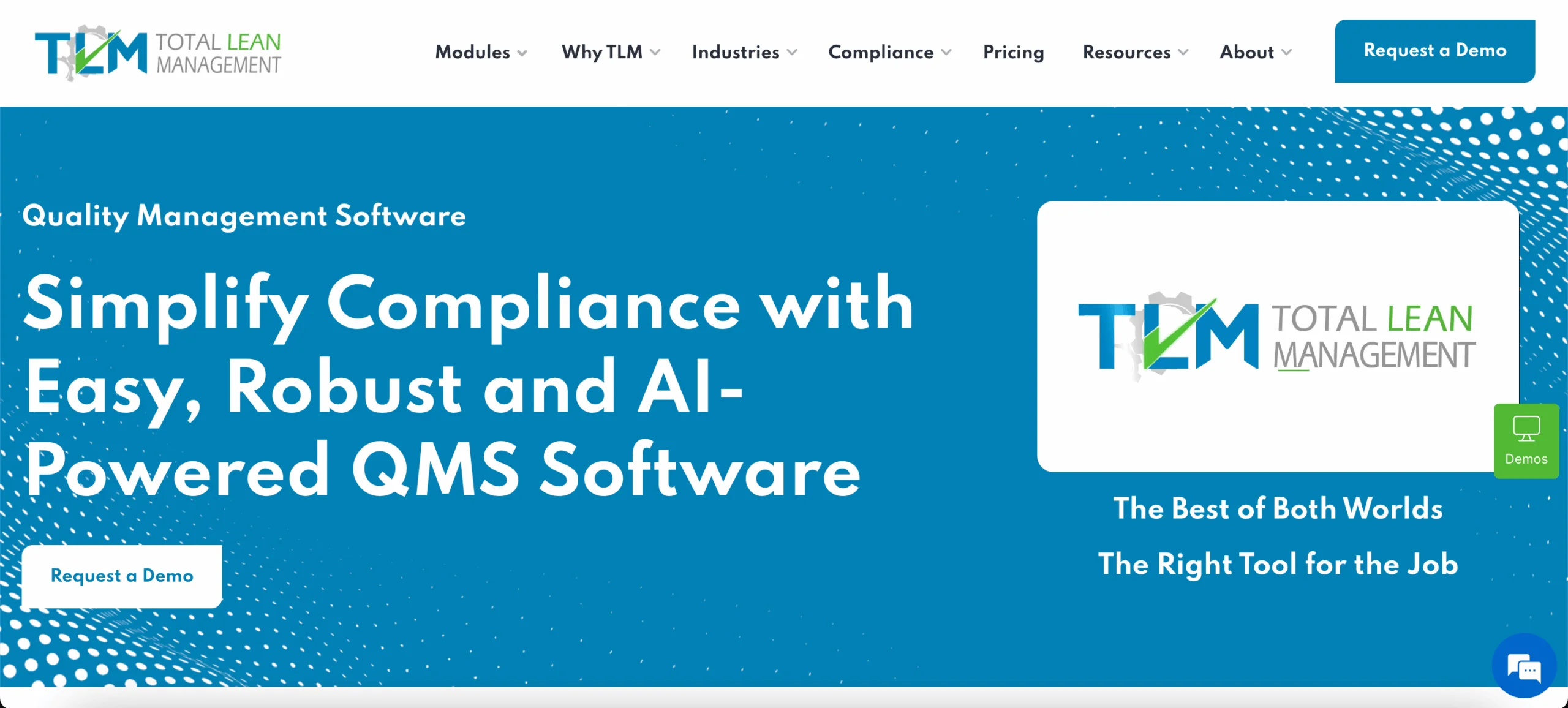
Total Lean Management (TLM) is a QMS platform for organizations operating under strict regulatory oversight.
It supports International Organization for Standardization (ISO) standards and 21 CFR Part 11 requirements, making it a practical option for manufacturers and medical device companies preparing for audits.
Unlike many QT9 QMS alternatives, TLM separates oversight from daily execution. Managers work inside the core system, while employees complete assigned tasks through a companion web app.
That model keeps document approvals, CAPAs, and audit follow-ups progressing instead of sitting in someone’s inbox.
Configured to Match Your Operations
TLM lets you configure workflows to match how your organization runs. During implementation, adjustments are part of the process, not treated as special exceptions.
If your approval chains or documentation setup differ from standard templates, you can customize the system accordingly.
Strong Support for ISO and FDA Environments
TLM includes template procedures aligned with ISO 9001, 13485, 17025, 16949, 27001, and 22000. Validation templates help accelerate ISO 13485 certification for medical device companies.
Both applications meet 21 CFR Part 11 requirements.
Main Features
- Audit tracking with direct links between procedures and regulatory clauses
- CAPA workflows with structured root cause analysis
- Document control with automated reviewer assignments and training links
- Deviation and complaint tracking with built-in trend reporting
- Equipment calibration and maintenance tracking
- Custom form builder for unique internal records
- AI-assisted document review for compliance checks
TLM also offers implementation guidance and responsive customer support, so you’re not left configuring the system on your own.
2. MasterControl
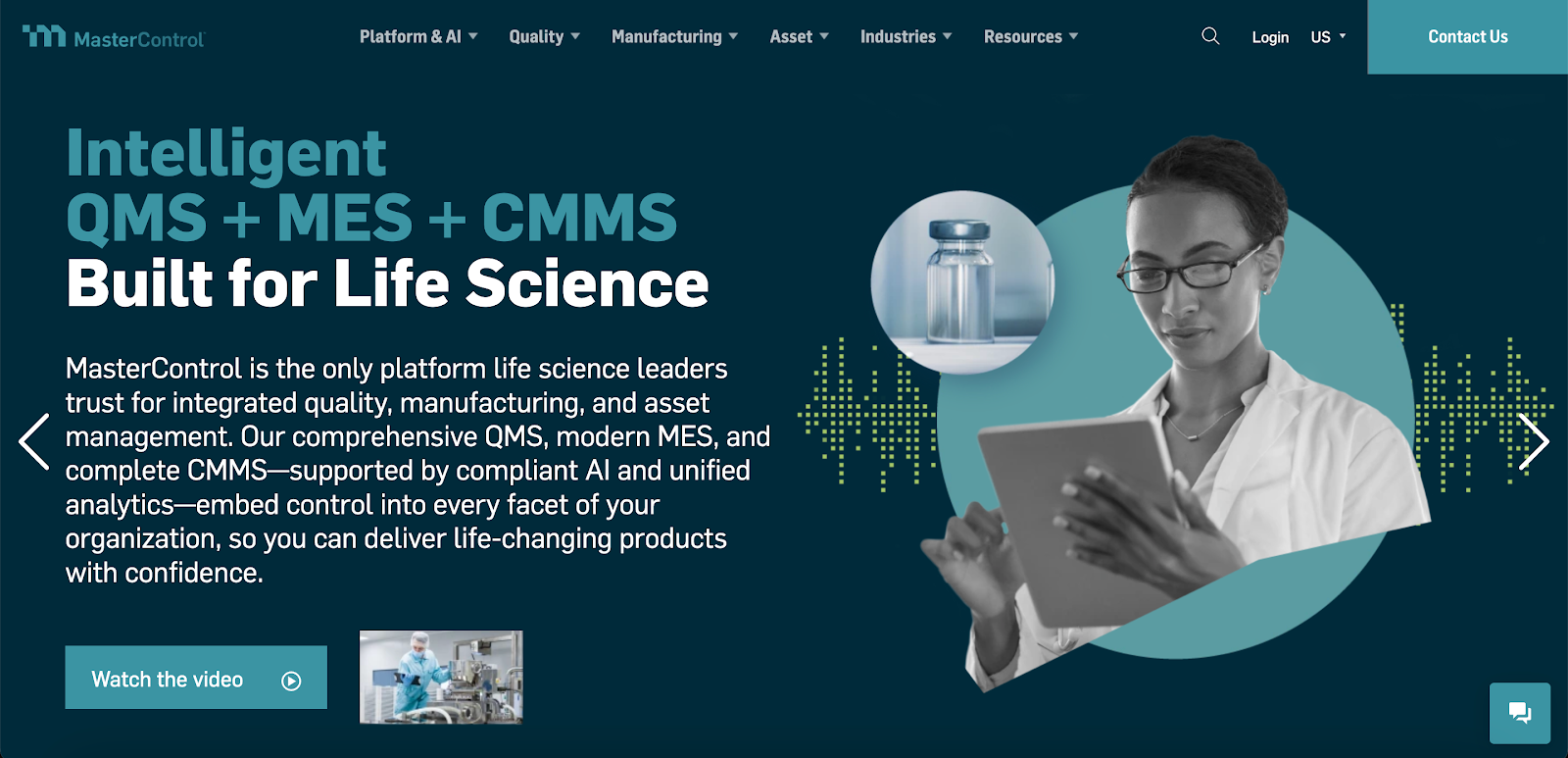
Image source: mastercontrol.com
MasterControl is commonly used in pharmaceutical, biotech, and medical device environments where documentation and regulatory oversight are tightly controlled.
Its Quality Excellence platform connects document control, training, event tracking, and reporting within one digital QMS system.
The system also incorporates artificial intelligence features trained specifically for regulated product settings.
MasterControl offers AI functions that operate within oversight controls, keeping quality professionals responsible for final decisions.
Main Features
- Configurable quality event forms with rules-based routing
- Document control with automated versioning, eSignatures, and 21 CFR Part 11 compliance
- AI-generated document change summaries and automated translation tools
- Automated training assignments triggered by document updates and CAPA records
- Advanced dashboards and key performance indicators (KPIs) through MasterControl Insights
- Risk-based validation tools that accelerate implementation and upgrades
Critical Considerations
MasterControl can take time to implement and learn, particularly for teams new to enterprise-level software. Expect a structured onboarding period before users are fully comfortable with modules and forms.
Users note limitations in form formatting, including restricted text styling and limited ability to embed images in complaint records. Others report session timeouts and dropdown constraints that can disrupt ongoing tasks.
3. Ideagen
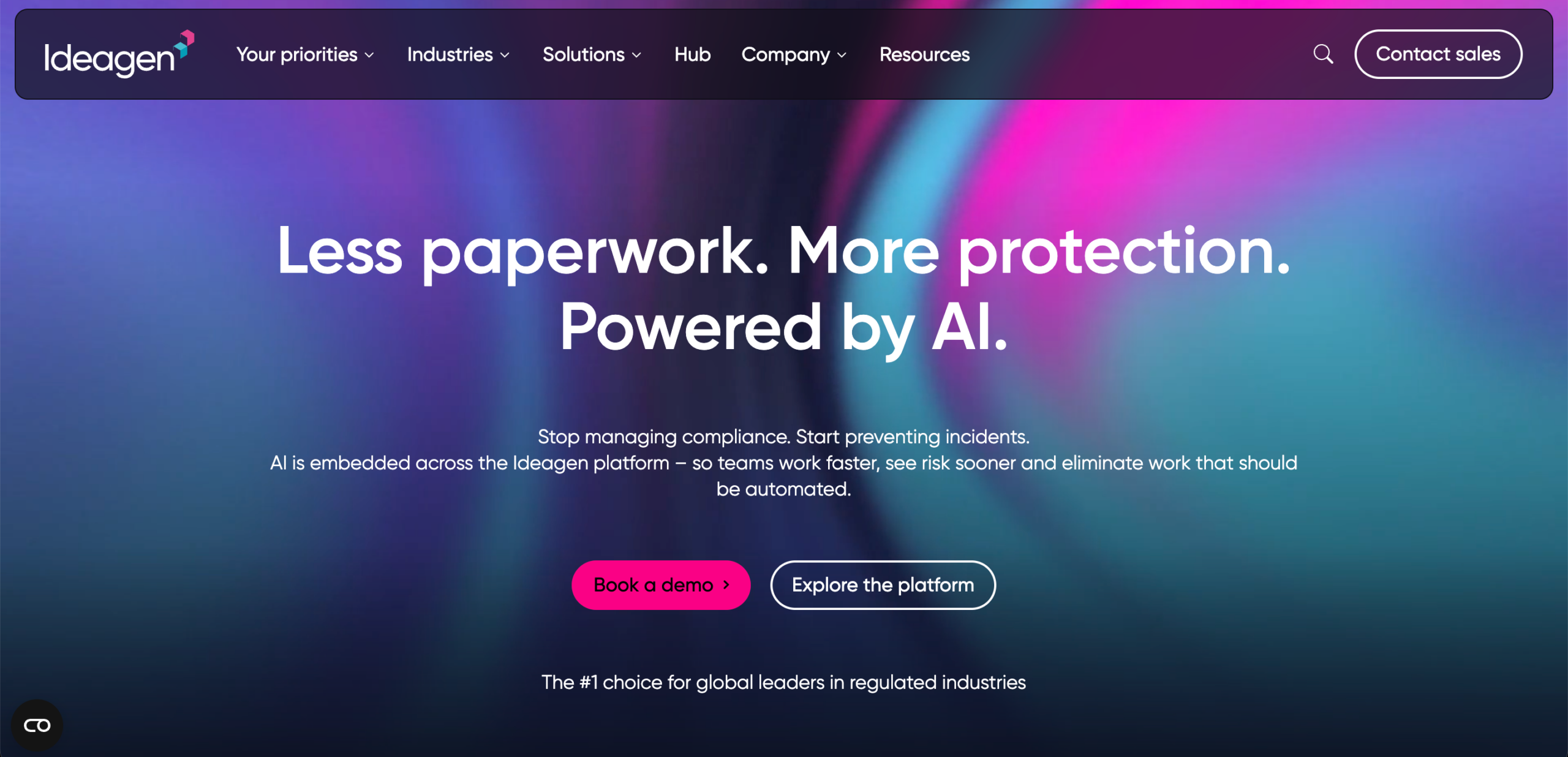
Image source: ideagen.com
Ideagen quality management software focuses on helping organizations replace paper-driven compliance work with automated workflows and embedded AI assistance.
Instead of tracking regulations manually, the system monitors standards updates and guides users through required documentation steps.
It places heavy emphasis on proactive oversight. Regulatory requirements are embedded into workflows, so updates to standards don’t get overlooked during routine operations.
Main Features
- AI-assisted document review and policy drafting
- Configurable workflows that digitize paper-based processes
- Automated KPI tracking tied to operational performance
- Built in CAPA workflows with structured investigation steps
- Audit preparation tools with standardized checklists and evidence tracking
- Regulatory monitoring that tracks ISO standards and jurisdictional changes
Critical Considerations
Some users describe the platform as admin-heavy, particularly when updating job roles or competency requirements. Changes can involve multiple manual steps.
There are also reports of limited connectivity between certain areas, such as personnel records and document modules.
A few users mention that standard support may not meet expectations, with enhanced support available at additional cost.
4. Qualio

Image source: qualio.com
Qualio is a cloud-based QMS used primarily in life sciences, including medical device, biotech, and pharmaceutical companies.
It helps teams manage quality processes without relying on paper records or disconnected tools. The focus is on strengthening compliance while keeping patient safety central to daily operations.
The platform brings document control, design control, risk management, training management, and audit management into one integrated platform.
This connection supports traceability from product development through post-market activities and helps drive continuous improvement.
Main Features
- Document lifecycle management with standardized templates and compliant eSignatures
- Design control workspace linking requirements, risk assessment, and product records
- Embedded risk management tied directly to product lifecycle activities
- Automated training management based on roles and document updates
- Change management workflows with detailed audit trails
Critical Considerations
Some users appreciate the intuitive interface and collaboration features. However, revision history and approval details aren’t always visible at a glance and may require opening individual documents.
Users report that filtering documents by number or name can require extra navigation. Updating document links, particularly within design control records, may also involve additional manual steps.
5. ComplianceQuest
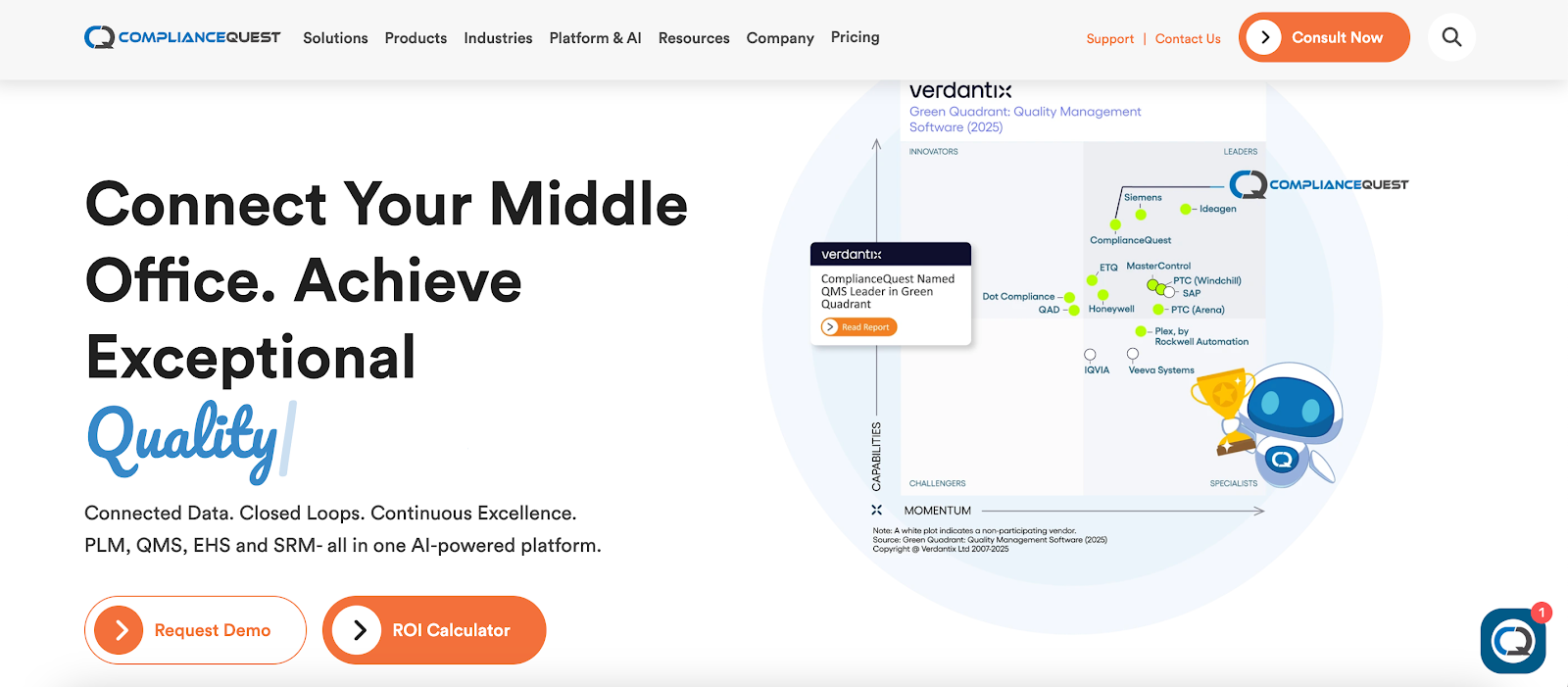
Image source: compliancequest.com
ComplianceQuest runs on the Salesforce platform and delivers a cloud-based quality system for regulated companies.
It connects audits, corrective actions, inspections, change control, and equipment records so teams can monitor activity from one centralized dashboard.
Since it runs on Salesforce, many large organizations appreciate the security model and scalability. It also allows seamless integration with other systems already operating in a Salesforce environment.
Main Features
- Audit planning, scheduling, and reporting with configurable workflows
- Closed-loop CAPA with structured investigation tools and AI-driven categorization
- Change control tracking with documented impact assessments
- Equipment management with calibration scheduling and maintenance tracking
- Nonconformance tracking with interactive root cause analysis dashboards
- Executive dashboards with advanced data analysis
Critical Considerations
Some users value the centralized audit capabilities and documentation tools. Others report frustration with repeated password prompts during routine tasks.
Search functionality can be limiting unless you know exactly what you’re looking for.
There are also reports that bulk uploading legacy documentation can be time-consuming, which may extend transition timelines when moving away from paper-based systems.
6. ETQ Reliance
Image source: etq.com
ETQ Reliance is often used by large enterprises and companies operating in highly regulated industries.
It combines document control, CAPA, audit tracking, training, and analytics within a single platform, so quality data isn’t scattered across multiple tools.
The system handles high volumes of records while supporting compliance management at scale.
Organizations with complex product lines or detailed regulatory requirements often choose ETQ Reliance for its configurable modules and ability to adapt to specific operational needs.
Main Features
- Document control with automated revision tracking and centralized records
- Training management with role-based assignments and progress monitoring
- Audit management with mobile access for on-site audits
- Corrective action workflows with predictive alerts
- Advanced analytics for trend visibility and performance tracking
- Codeless tools to modify workflows and create custom applications
Critical Considerations
Users report that changing workflows after initial setup can require coordination and time. Updating forms or approval paths isn’t always immediate.
There are also comments about the interface appearing dated and cumbersome when navigating large volumes of records.
A few users reported occasional system downtime, which can delay work during busy periods.
7. SimplerQMS
Image source: simplerqms.com
SimplerQMS was created for life sciences organizations, including medical device, pharmaceutical, biotech, and laboratory teams.
It comes fully validated and pre-configured, which can shorten the validation process and reduce the workload linked to implementation.
The platform includes a comprehensive suite of quality modules in one environment. All core modules, including document control, CAPA, training, audits, supplier oversight, and risk management, are included under one license.
A key differentiator is its Microsoft Office 365 integration. Your team can edit documents in Word or Excel while changes automatically sync to the system with a complete audit trail.
That reduces version control errors and helps maintain compliance without disrupting daily routines.
Main Features
- Document control with version tracking, eSignatures, and audit trails
- Training management with automated reminders and retraining workflows
- Design control linked to product lifecycle documentation
- CAPA management to address root causes and reduce recurrence
- Complaint management with traceability and reporting
- Audit management to support inspection readiness
Critical Considerations
Quality management teams highlight the user-friendly interface and the fact that all modules are available from day one.
However, some note that navigation and layout could be refined to make certain functions easier to locate.
There are minor interface inconsistencies and occasional additional configuration steps. These aren’t major barriers, but they can require a short adjustment period during onboarding.
How to Choose the Right QT9 QMS Replacement
Most organizations don’t start searching for QT9 QMS alternatives casually.
It usually happens when audits become more demanding, reporting expectations increase, or product lifecycle management becomes harder to control as operations expand.
At that point, you’re not just comparing feature lists. You’re evaluating oversight, traceability, and how quality connects to broader project management responsibilities.
The right system should match your specific requirements, protect product quality, and support long-term customer satisfaction.
Automation should reduce repetitive work. The user interface should make it easy to locate records and close actions efficiently.
As you evaluate QT9 QMS alternatives, focus on adaptability, validation support, and a cost-effective pricing structure that doesn’t require constant add-ons just to stay compliant.
Activate TLM and Gain Full Visibility Into Quality Operations

If you want a system that supports ISO certification and FDA compliance while aligning with how your organization actually operates, TLM deserves serious consideration.
TLM includes audit management, CAPA, deviation tracking, document control, equipment calibration, supplier oversight, and customer feedback in one all-inclusive solution.
Validation templates for ISO 13485- and 21 CFR Part 11-compliant applications are built in, providing full validation support from the start.
You’re not piecing together specific modules or managing disconnected tools. The system connects audits, corrective actions, and equipment records to help reduce risk and strengthen oversight.
The dual-application model supports diverse teams by separating administrative control from day-to-day execution.
During the 30-day supported trial, you can upload existing records, configure workflows, and evaluate the platform in your own environment.
FAQs About QT9 QMS Alternatives
What is the best QMS software?
The best QMS software is one that fits your regulatory requirements and operational complexity. It should include document control, CAPA, audits, and training without forcing you to add modules later.
Many organizations choose platforms like TLM for full validation support and complete functionality from day one.
What are the seven quality management systems?
The seven commonly recognized quality management systems are ISO 9001, ISO 13485, ISO 14001, ISO 17025, ISO 22000, AS9100, and IATF 16949.
Each standard applies to specific industries and regulatory environments. They define requirements for documentation, control, and continuous improvement.
What are the four types of quality control?
The four types of quality control are process control, acceptance sampling, control charts, and product inspection.
These methods monitor production, evaluate batches, track variation, and verify finished goods meet specifications. Their purpose is to maintain product quality and prevent defects before release.


 Demos
Demos